What’s the bravest thing you’ve ever done when no one was watching?

I took that journey into myself, that “road less traveled”. And I came out the other side a better person.
What’s the bravest thing you’ve ever done when no one was watching?
I took that journey into myself, that “road less traveled”. And I came out the other side a better person.
What is your favorite quote?
Letting go of the pain is not about forgetting the past; it’s about remembering the future.
Which languages do you speak and how did that impact your life?
Being able to speak a language is relevant. We use a very limited vocabulary every day, but we know a lot more words than we use. Therfore, we may understand a lot more words than we can speak. But we don’t need too many words to get by, and to get our basic needs met.
I grew up speaking English and went to a Welsh medium school, but I didn’t use Welsh until one of my sons went to school. We were living in a predominantly Welsh area, and we felt he would benefit from being educated in the Welsh stream, so I re-learned the language.
Three years ago, my youngest two were playing around with a language app but always running out of ‘lives’ with the free version. So, I paid for the family version of the app and decided that I wasn’t going to waste the money. I would learn Italian, like I’d always wanted to but never gotten around to it.
Since then, I’ve moved on to other languages. So, as of today, I speak:
English, Welsh, Italian, Spanish, French, Portuguese. I can also sign a limited vocabulary in British Sign Language.
I first realised the significance when I was sitting behind a young man who was a deaf mute. His interpreter and family had gone to get lunch for him and he was sitting alone in the midst of all these people enjoying their own conversations.
I tapped him on the shoulder and spelled out, “Hi. My name is Michael.” And I’ll never forget the sheer joy on his face over the fact that someone had ‘spoken’ to him in his language.
I’ve had similar experiences with others, over the years. Even a simple greeting in the person’s mother tongue makes a huge difference in their life. Suddenly, they’re not alone. Suddenly, they have a friendly face in front of them instead of a sea of potentially frightening mystery.
A friend told me about a conversion he once had with a native Welsh speaker. It went something like this:
“When I converse, I converse in Welsh or English. When I watch TV, I watch TV in Welsh or English. When I go shopping, I go shopping in Welsh or English. When I pray, I pray in Welsh. That’s the language of my heart.”
That’s the impact. We talk of speaking in someone’s ‘native tongue’. What we really mean is speaking in the language of their heart.
Then there’s our heart. Our heart expands when we learn another language. Our heart is touched because we’ve touched someone else’s heart.
And when we touch someone’s heart, anything can happen.
What’s a time you followed your gut and it turned out to be exactly right?
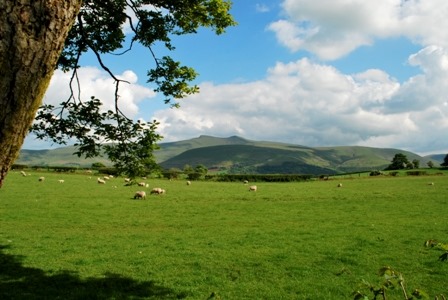
It was the end of our 37th wedding anniversary holiday when my wife and I stopped at the Pont-ar-Daf car park at the foot of Pen y Fan in the Brecon Beacons for a rest after a long drive. We decided to stretch our legs a little with a stroll up the path leading to the summit. I had reached the top with a friend a few weeks earlier but my wife had never attempted it.
After a short walk, I asked my wife, who suffered from mild asthma, if she wanted to go back to the car. She asked me what the view was like from the ridge that we could see. I said it’s worth seeing and she said, “Let’s see how we go.”
We walked on steadily, one foot in front of the other, got to the ridge and, indeed, the view was worth the effort. I asked if she was ready to go back to the car and she asked which peak was Pen y Fan. When I pointed it out she said, “Let’s see how we go.”
We kept waking and reached the summit, with its view across the whole of South and Mid Wales just as everyone else was leaving. We were left alone at the top for about ten minutes. It was probably the most emotional experience of our lives together.
We took the required photos and just sat there, alone together, tears in our eyes from the waves of emotions. Getting to the top at the end of an anniversary holiday was well worth the effort. It was a shared experience that drew us even closer together than we had ever been before. And all because of her gut feeling, “Let’s see how we go.” It was the first and only time we ascended Pen y Fan despite living in its shadow for over 40 years together.
The following year, there was upheaval in the family. But that shared experience had given us the strength to keep going and just “see how we go,” one foot in front of the other, in the face of trials.
I rarely directly share personal experiences, but this one has kept me going despite everything that life has thrown at us.
Just over five years later, my wife’s asthma turned out to be lung cancer, and she passed away a few months before what would have been our 43rd anniversary. But that shared experience has kept me going, still dealing with the upheaval in the family, still putting one foot in front of the other, still telling myself, “Let’s see how we go.”
“I just wish they would say, ‘Thank you,’ now and then.”

As a care-giver I am aware that one of the most common complaints that fellow care-givers utter is, “I just wish they would say, ‘Thank you,’ now and then.”
It’s true. Although most people who require care really appreciate the help that they receive, many are in too much pain, either physically, mentally, spiritually, or emotionally, to think about showing gratitude. It isn’t deliberate. They just don’t know how to say it in the circumstances.
For example, one young girl told her grandfather, who is also her guardian, that she wished he was dead, mainly because he would not allow her to cause injury to her brother. The grandfather merely said, “Yes. I know. I can imagine you feel like that.”
Deep down inside, however, he wondered whether he was cut out for this role, or should he simply give up and send the children into foster care.
Next morning, there was a gentle knock on his bedroom door and his granddaughter walked in with a home-made card with a little drawing and the words, “I love you,” hand-written on the front. Inside was another message saying that she loved him, among other things.
Notable by its absence, though, was the phrase, “Thank you.” She just couldn’t bring herself to say it.
The Cosmos Thanks You
Some time ago, I was doing some work on Compassion Fatigue; mainly from the perspective of how to avoid it. As synchronicity would have it, though, I also went for an eye test that week.
After my test, I sat down with the “Frames Specialist” (read, sales woman) to choose new glasses. She commented that my choice of varifocals was useful for work.
I explained that I don’t work in the conventional sense. I am, for want of an easier explanation, a foster carer.
She immediately pounced on it and this random total stranger told me, “You’re doing a fantastic job. Well done.”
And I realised that it was not the first time something like that had happened.
A few years ago, my mother and I had taken the children to a café for lunch, and my granddaughter had been playing up. My mother, being old school, could not understand why I was dealing with the child in such a kindly manner. To be honest, the behaviour was getting to me, too!
Yet, as we left, a random total stranger sitting at a nearby table put his hand on my arm to stop me. He looked me in the eye and said, “You’re doing a fantastic job. Well done.”
Thinking about all these experiences it made me realise how often such things happen and that, even though we may not receive the expected gratitude from those we are charged to care for, we do receive gratitude. It’s as if the cosmos appreciates the work that we are doing to care for these poor souls who cannot care for themselves; who might otherwise be left to fend for themselves, maybe on the street.
So, next time the person you care for shows a lack of gratitude, think about all the times someone else has said it. And wonder whether, since that person doesn’t really know you, is it, perhaps, that the person was moved to say something, just when you needed it most?

